
Why More Investors Are Looking at UK Property Now—and What Actually Makes It Work
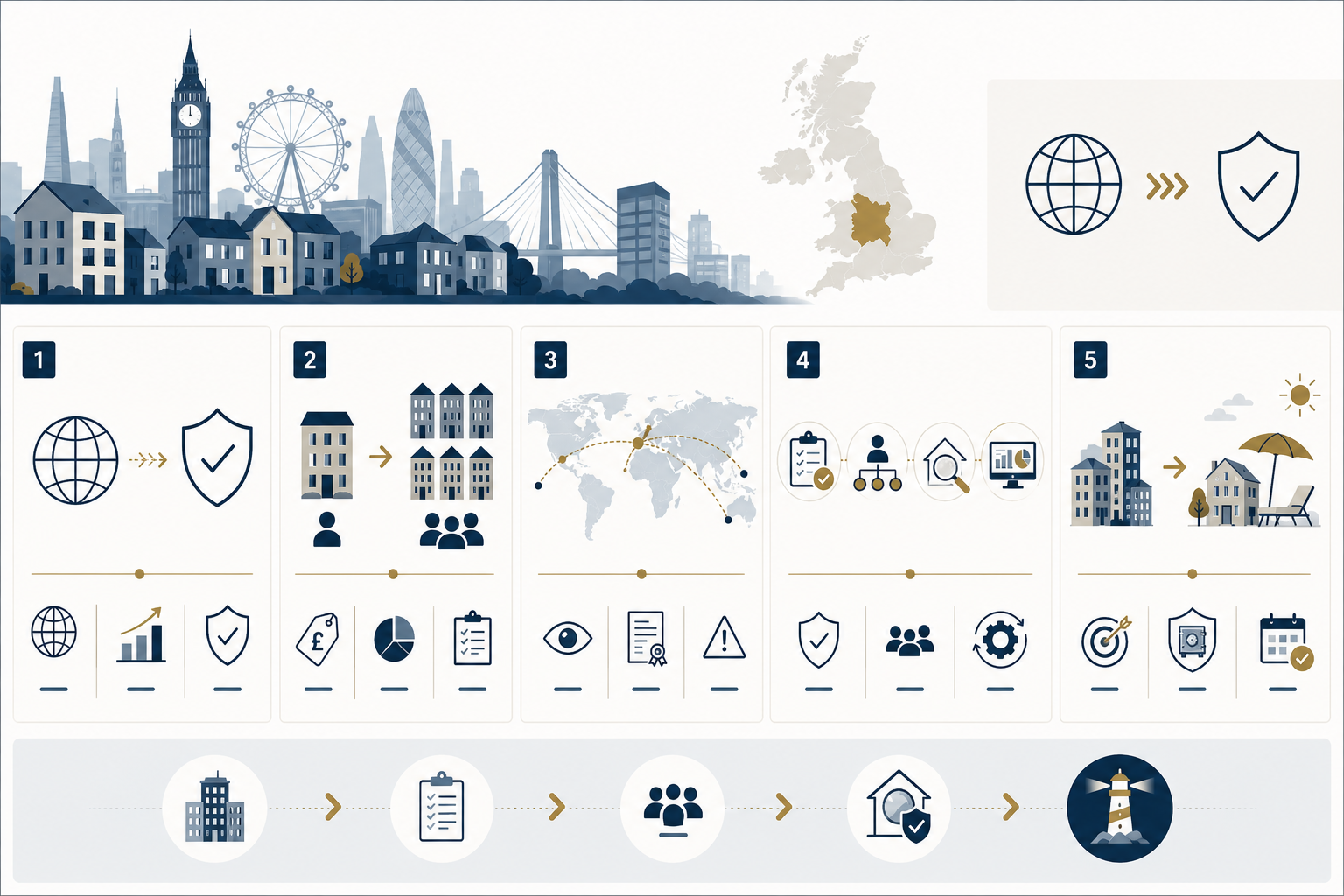
While global market volatility persists, the UK property sector, and specifically hubs like Greater Manchester, remain a "Safe Haven" for international capital. However, the shift in 2026 isn't just about acquisition; it is about operational resilience. As the Renters’ Rights Act and tighter regulations take hold, the value of a property is no longer found in the yield alone, but in the integrity of the management system supporting it.
1. The Flight to Stability: Beyond the Headlines
Global economic shifts are forcing a more calculated approach to capital placement. While some markets are experiencing uncharacteristic quiet, the UK remains relatively steady.
Regions like Greater Manchester and the North West are prime examples of this "quiet backing." Strategic investments in transport infrastructure and housing are shaping long-term demand in ways that aren't yet visible on a standard property listing. For the sophisticated investor, these macro-indicators are more important than short-term price fluctuations.
2. Scaling from Ownership to Asset Management
There is a fundamental shift in behaviour when an investor moves from owning a single unit to managing a significant portfolio (e.g., 30+ units).
The Individual Deal: Focuses on price and immediate yield.
The Portfolio Strategy: Focuses on whether the assets actually run properly.
When managing at scale and especially from a distance, the challenge isn't the purchase; it is the regulatory environment. With the 2026 legislative landscape moving quickly, "good business" is now defined by how well a portfolio can withstand an audit, not just how much rent it collects.
3. The Distance Paradox: Running Property Remotely
For investors in Dubai, Singapore, or London, buying is the easy part. The real friction begins post-handover. Managing at a distance means relying on:
Secondary Information: Data you didn't personally gather.
Third-Party Systems: Operations you can't physically see.
Assumed Compliance: Certificates that "should" exist but aren't evidenced.
This "visibility gap" turns proactive investment into reactive management. In an era of tighter regulation, this gap is where the majority of investment risk lives.
4. What Actually Determines Property Performance?
Traditional metrics like price, yield, and location are the "hardware" of an investment. But the "software"—the management layer—determines whether that hardware performs or crashes.
A high-performance asset requires:
Documented Evidence: If a safety check isn't recorded, it doesn't exist.
Clear Responsibility: Defined oversight that removes the "scramble" for information.
Operational Ground-Truth: Matching the spreadsheet data to the reality on the street.
5. The Shift from "More" to "Better"
Most investors don't actually want a higher property count; they want mental freedom. They want a portfolio that functions as a "Safe Harbor" and is running in the background without constant input, paperwork chasing, or regulatory surprises.
Once you shift your objective from "finding the next deal" to "building a stable system," your buying decisions change. You stop looking for "flashy" and start looking for predictable.
Conclusion: The Difference is the Management Layer
The opportunity in UK property remains strong for those who understand that the headline numbers are secondary to the operational setup. Especially for remote investors, the success of the investment depends entirely on how it performs once everything is in motion.
Real performance isn't found at the point of sale. Real performance is found in the system that carries the distance.