
What Actually Makes a Good UK Buy-to-Let Investment? (Beyond Price and Yield)
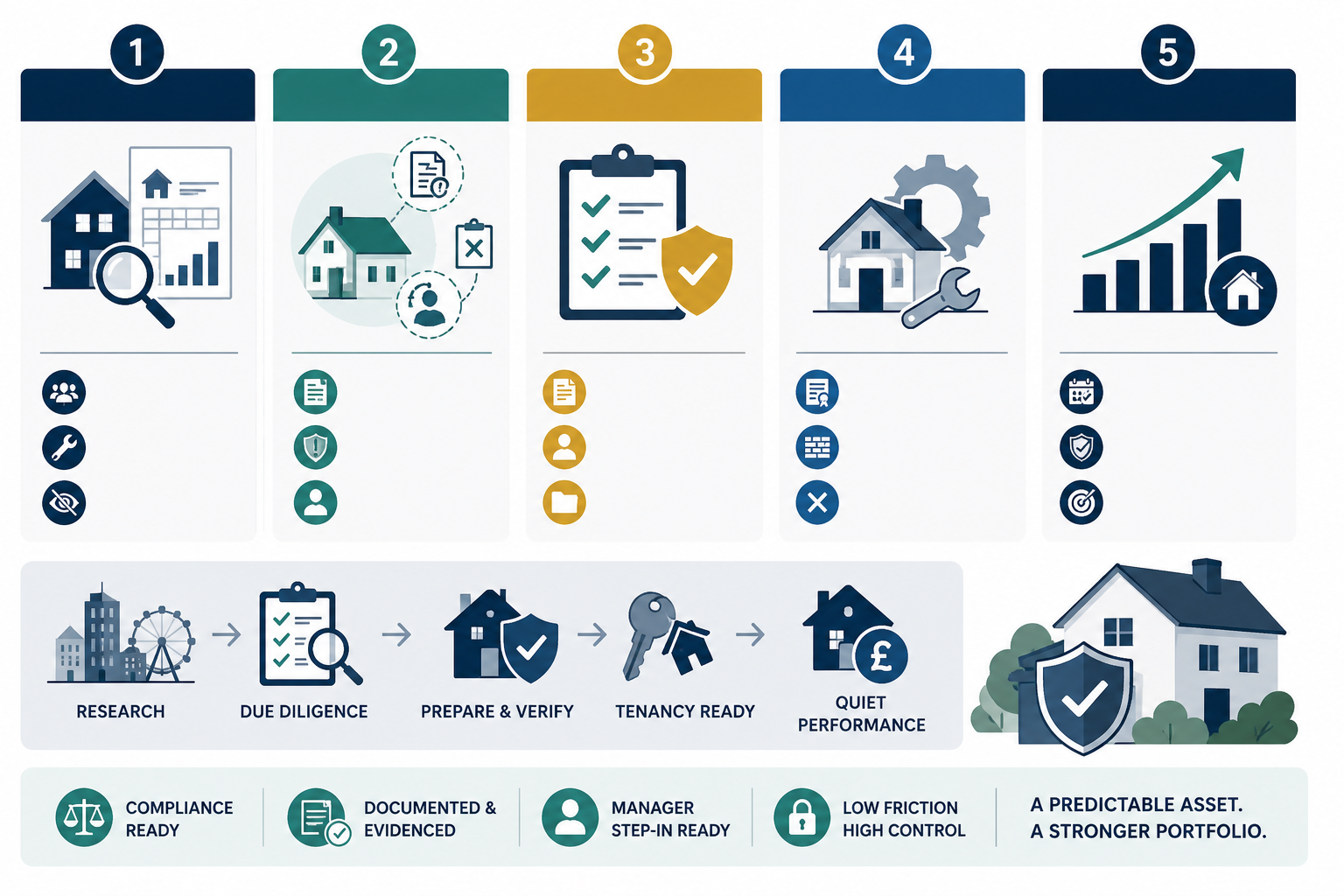
Most property problems are "baked in" at the point of purchase. While traditional metrics like yield and location are essential, they are incomplete. A high-performing asset is defined by its operational resilience: documented compliance, verified "ground-truth" data, and a system that functions without the owner's constant intervention.
1. Why Price and Yield are Only the Starting Point
It is relatively simple to find UK properties that "stack up" on a spreadsheet. A strong headline yield or a low entry price can be seductive, but these figures are static. They fail to account for the Management Layer—the ongoing friction that determines your actual net return.
A property can look exceptional on paper and still fail because:
Tenant Stability: The numbers don't show the transience of a specific street.
Operational Drag: High yields often mask high maintenance requirements.
Hidden Friction: The "deal" doesn't reveal the lack of a professionalized system behind the asset.
2. The Visibility Gap: Why Problems Appear Post-Purchase
Many property issues are invisible during the "honeymoon period" of a purchase. When the keys are handed over and the first rent arrives, everything feels successful. However, gaps eventually appear in:
Compliance History: Information that was assumed rather than evidenced.
Regulatory Readiness: Missing certificates or outdated safety checks.
Reactive Management: Once a tenant is in place, you are no longer in control of the setup; you are simply reacting to problems.
3. The "Safe Haven" Filter: What to Look For
Before we move forward with any property for our investors in London, Dubai, or Singapore, it must pass a rigorous internal filter. We look for three specific markers of a "Quiet Performer":
Zero Reliance on Memory: If a maintenance event or certificate isn't documented and evidenced, it doesn't exist.
The "Step-In" Test: Could a new manager take over the property tomorrow morning without needing to ask a single question?
Visible Compliance: Gas Safety, EICR, and Right to Rent documentation must be up-to-date and instantly accessible.
4. Fixing the Friction Before the Tenancy
Many investors take on unnecessary risk by buying properties that are "almost" ready. Our approach is to close the gap before the investment is finalized.
Operational Stacking: If a certificate is missing, we obtain it.
Structural Resolution: Layout concerns or minor repairs are handled upfront.
The "No" Factor: If a property doesn't stack up operationally, we walk away.
5. The Real Measure of Success
A strong UK Buy-to-Let isn't a "flashy" deal; it is a predictable asset. By shifting focus from the point of sale to the day-to-day performance, you gain:
Consistency: A tenancy that settles because the home actually works.
Confidence: Knowing that the asset meets all 2026/2027 regulatory standards (such as the Renters' Rights Act).
Predictability: Turning a high-pressure asset into a quiet financial anchor.
Conclusion
Price and yield will always be relevant, but they are only one side of the coin. The difference between an average investment and a high-performance portfolio is preparation. By documenting, evidencing, and sorting the "invisible" bits upfront, you avoid the problems most landlords are forced to manage.