
What UK Property Really Looks Like Inside a 1,100-Unit Operation
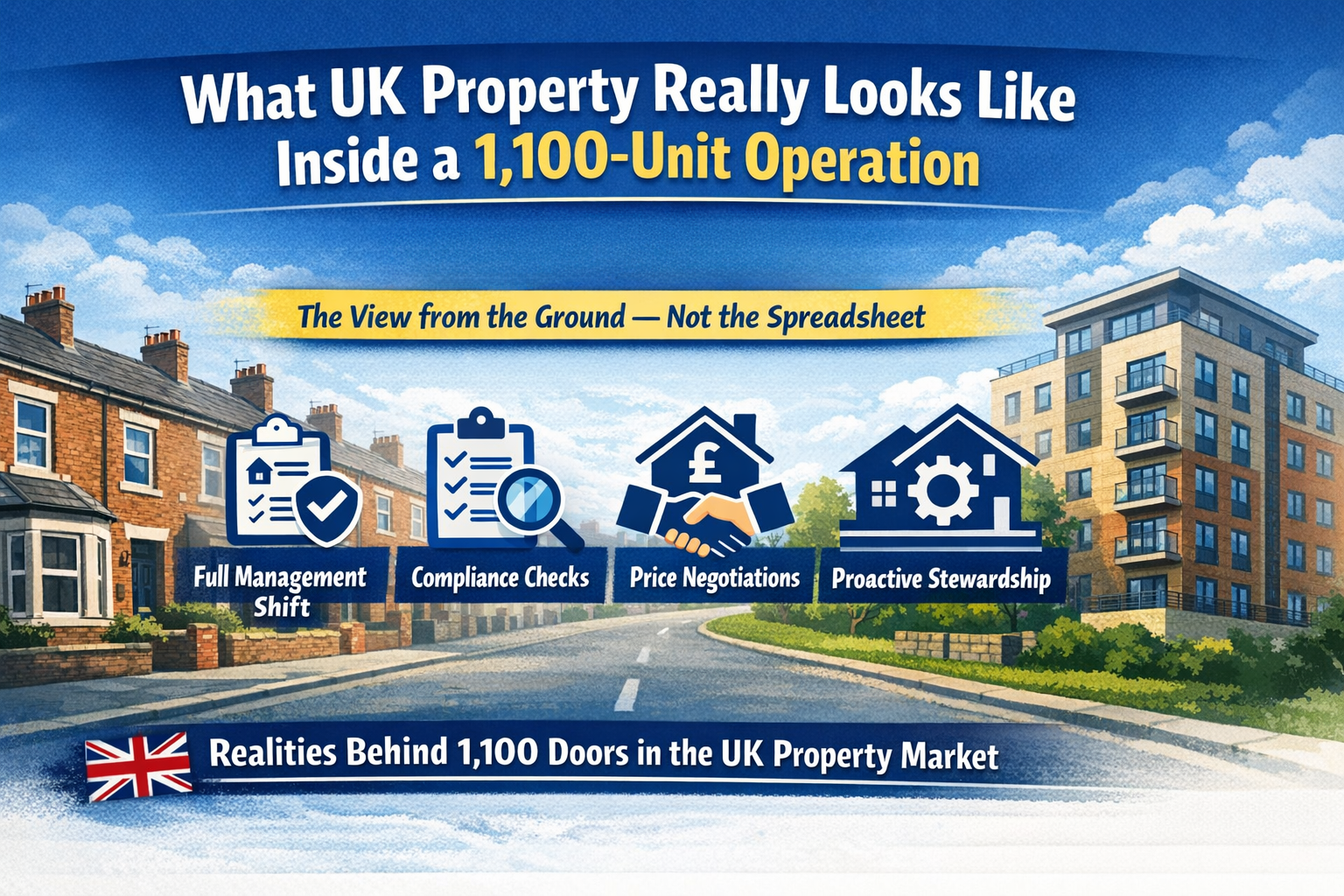
The View from the Ground - Not the Spreadsheet
Earlier this week, we shared a perspective from Manchester.
Not a macro view.
Not interest rate speculation.
Not headline commentary.
But a view from inside the engine room of a live, 1,100-unit operation.
Because the reality of UK property in 2026 isn’t defined by charts - it’s defined by what happens on the ground, every single day.
What “Ground Truth” Looked Like This Week
While headlines continue to debate interest rates and market direction, our team has been focused on the operational realities that directly shape investor returns.
Here’s what that actually looked like:
1. The Shift to Full Management
We are seeing a clear behavioural shift among landlords.
More are moving from Rent Collect to Fully Managed services.
Why?
Because in 2026, the administrative burden is no longer manageable as a side activity.
Across Leigh, several landlords upgraded their portfolios this week — choosing operational stability over marginal savings in fees.
The takeaway:
The cost of mismanagement now outweighs the cost of professional management.
2. The Compliance Grind
This week alone, our teams audited dozens of compliance items across Rochdale and Leigh:
Gas Safety Certificates
Tenant fee structures
Documentation checks
In today’s regulatory environment, compliance is not optional — it is constant.
And more importantly, it is operational.
The takeaway:
Scale is not just about growth — it is a protection mechanism.
A strong back office prevents small oversights from becoming major liabilities.
3. Tenant Price Sensitivity Is Still Real
Despite broader narratives around rental growth, pricing discipline remains critical.
One Rochdale property recently agreed at £250,000 after several rounds of negotiation.
This is a useful reminder:
Tenants are still price-sensitive
Buyers still negotiate
Markets still reward realism over optimism
The takeaway:
Professional negotiation still drives outcomes — not assumptions.
4. Proactive Asset Stewardship
Perhaps the biggest shift is not reactive - but proactive.
We are increasingly implementing:
Internal property health checks
Structured audit folders
Early issue detection systems
This allows us to identify risks before they escalate into problems.
The takeaway:
Modern property management is no longer reactive maintenance — it is system-driven oversight.
The Bigger Picture: A Market That Is Professionalising
There is a narrative that UK property is becoming “difficult.”
That is only partially true.
What is actually happening is this:
The market is becoming more professional.
The accidental landlord is finding it harder to operate
The organised operator is gaining ground
Because success in today’s environment is no longer about simply owning property.
It is about running a system.
For International Investors Watching From Afar
If you are observing the UK market from overseas - whether from Dubai, Singapore, or Hong Kong — it is easy to focus on:
Interest rates
Price indices
Yield projections
But those are only part of the equation.
What actually determines performance is the operational layer beneath it.
You don’t need a deal finder.
You need an operating system.
Final Thought
UK property in 2026 is not broken.
It is evolving.
And the investors who are building structured, system-led portfolios are the ones continuing to expand - quietly, consistently, and with control.
Not theory. Just the reality behind 1,100 doors. 🇬🇧
Northbridge Property Advisory
A bridge between international capital and UK property operations