
How to Build a Business That Becomes Less Dependent on Its Owner
I've spent this week writing about something I first learned in schools and am now rediscovering as a business owner.
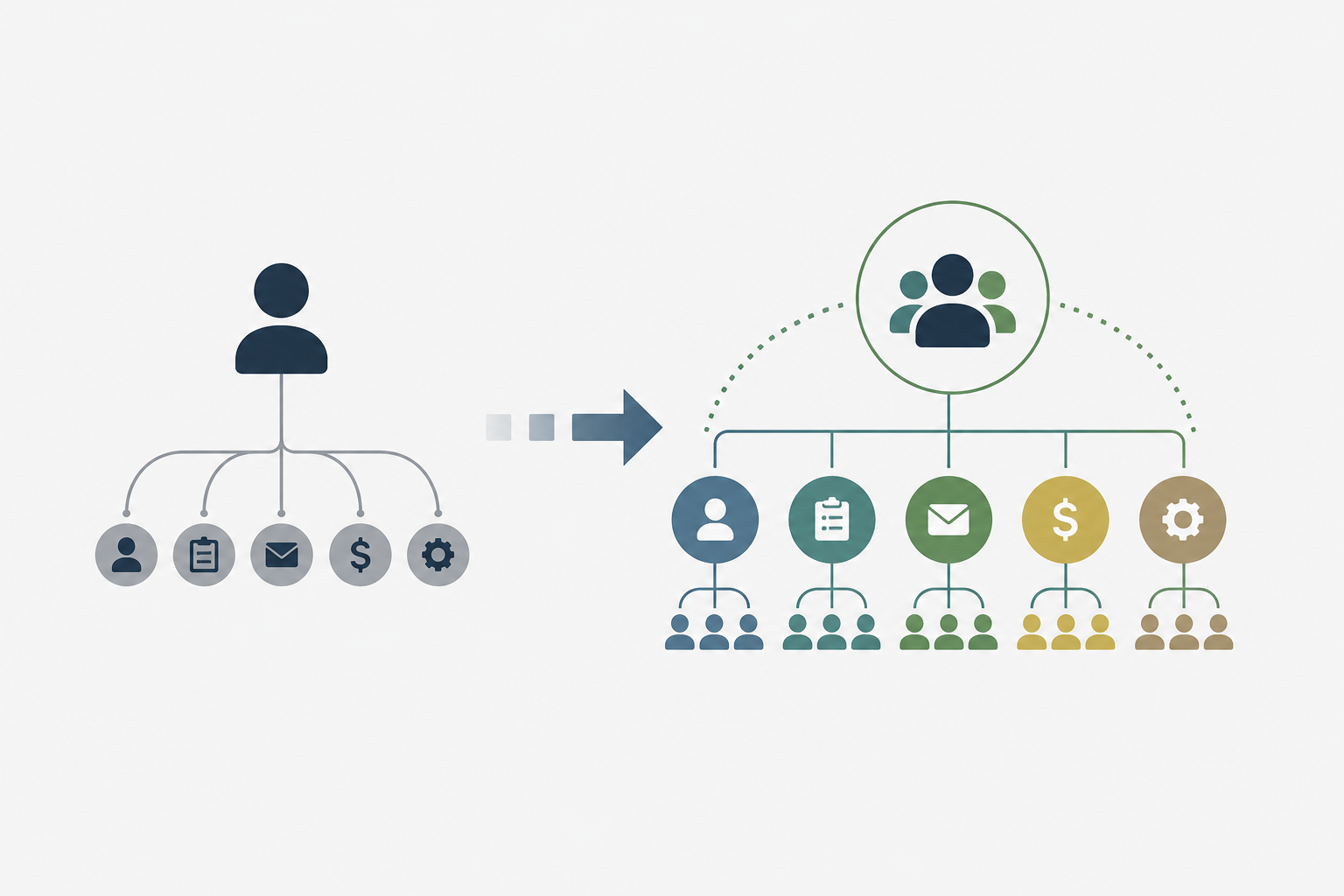
Good leadership should eventually make the organisation less dependent on the leader.
That sounds fairly obvious.
In practice, I'm not sure it is.
As a business grows, the owner usually accumulates knowledge. You know the clients, understand the history, remember why decisions were made and become quite good at solving the problems that repeatedly appear.
Before long, everything starts travelling through you.
That can feel reassuring. It can even feel like good leadership.
My experience in schools taught me to be rather wary of it.
What Does Good Delegation Actually Look Like?
For years, I thought being a good leader meant being good at solving problems.
Schools rather encourage that. Something happens, somebody appears at your door and you're expected to know what to do.
Eventually I realised that if everything still needed me to solve it, I probably wasn't doing part of my job particularly well.
The better approach was to develop other people who could make good decisions without me.
I've carried that directly into business.
When we bought our first letting agency, I was inevitably involved in almost everything because I needed to understand what we'd bought. As we've grown, however, the objective has changed.
I don't want to create an organisation full of people who are very good at doing what the owners tell them.
I want capable people who can exercise judgement themselves.
Delegation Requires Direction
That raises another question.
How can somebody make good decisions independently if they don't understand what you're trying to achieve?
This came up recently when one of my senior team was dealing with a complicated problem. There were several possible explanations, incomplete information and more evidence still to gather.
Giving her a detailed list of instructions wouldn't have been particularly useful because the situation was still changing.
Instead, we established what we knew, what remained uncertain, the principles that should guide the work and where we were trying to get to.
She could then work out much of the route herself.
That's the difference, I think, between delegation and simply allocating work.
People need enough context to understand the destination. Once they have that, they can make sensible decisions when circumstances inevitably change.
Why Does a Business Need a Clear Vision?
I've also spent quite a lot of time recently writing down what I think our businesses might look like several years from now.
Not a forecast and certainly not a prediction.
It's more a description of the organisation we're trying to build.
I used to do something similar when leading change in schools. Before changing a curriculum, department or leadership structure, it was useful to ask a very simple question:
What does better actually look like?
I'm finding that question equally useful in business.
I don't know exactly what our final organisational structure will look like. Nor should I. We'll learn things, circumstances will change and some of our current thinking will inevitably prove wrong.
But I do have a reasonably clear idea of what I want us to become.
I'm increasingly thinking of it as an enduring organisation: a business with capable people, clear leadership and systems that allow it to grow without becoming increasingly dependent on the people who happen to own it.
Articulating that future is useful because it gives us something against which to test today's decisions.
Does this appointment move us towards that organisation?
Will this system still work when we're twice the size?
Are we solving today's problem in a way that creates another problem later?
Vision isn't the same as certainty.
Sometimes describing the destination simply helps you choose the next step.
Should You Change the Structure of an Acquired Business?
One thing I've learned from buying businesses is that you inherit far more than customers and accounts.
You inherit the way things have always been done.
You inherit job descriptions, responsibilities, meetings, systems and sometimes fairly elaborate workarounds that made perfect sense to somebody several years ago.
Schools were exactly the same.
Occasionally I'd ask why something was done in a particular way and discover that nobody really knew anymore. It had simply been passed from one year to the next until "we've always done it this way" became the explanation.
We've deliberately avoided rushing into acquired businesses and immediately changing everything.
There's enormous value in understanding why something works before deciding it needs fixing.
Eventually, though, I think you have to ask:
If we were building this business today, for where we want it to be in three or five years, would we build it this way?
Sometimes the answer will be yes.
Sometimes it won't.
That doesn't mean the previous structure was wrong. It may simply have been designed for a different organisation at a different stage of its development.
Respecting what came before doesn't require you to be constrained by it.
How Do You Reduce Owner Dependence?
I don't think the answer is simply "delegate more."
Owner dependence reduces when several things happen together:
capable people are developed and trusted;
those people understand where the organisation is heading;
responsibility comes with enough context to exercise judgement;
important knowledge is captured in systems rather than remaining in people's heads;
organisational structures evolve as the business changes;
owners resist the temptation to remain the answer to every question.
That last one may be the hardest.
Being needed can be quite seductive.
You solve something quickly and feel useful. But if you're still solving exactly the same operational problem several years later, perhaps you haven't actually solved it at all.
You've simply become part of the process.
Does an Owner-Independent Business Still Need Leadership?
Absolutely.
I don't particularly like the idea of building a "self-managing" business because it implies that leadership somehow disappears.
That's not what I'm trying to achieve.
Peter and I remain closely involved in our businesses and, at this stage of their development, I think we should be.
What I want is for the nature of that involvement to keep changing.
Problems that once required us should gradually be handled elsewhere. That creates the capacity for us to think about the next set of problems: strategy, investment, acquisitions, capital allocation and the longer-term direction of the Group.
The objective isn't to make the owner redundant.
It's to stop the owner becoming the constraint.
Building an Enduring Organisation
Perhaps this is the biggest connection I've discovered between my previous career in education and what I'm doing now.
The best schools aren't built around one individual.
Leaders come and go. Teachers move on. Students certainly do. Yet good institutions preserve knowledge, develop new leaders, maintain their culture and continue evolving.
That's an enduring organisation.
I'm increasingly convinced that's what we're trying to build in business too.
Not simply a collection of companies that Peter and I happen to own, but an organisation with enough capability, direction and institutional knowledge to continue developing beyond the people who originally created it.
That won't happen quickly, and we'll undoubtedly make mistakes along the way.
But it gives me a useful test.
If the business becomes larger while becoming more dependent on us, we've probably just created more work.
If it becomes larger while the people, systems and organisation around us become more capable, then we're actually building something.
Growth shouldn't just make a business bigger.
It should make the organisation stronger.